
Redetermination Ready.  Data Reconciled.  Risk Captured.

Smarter Medicaid risk analytics

To power care, compliance, and financial integrity.

Managed Medicaid

Overview

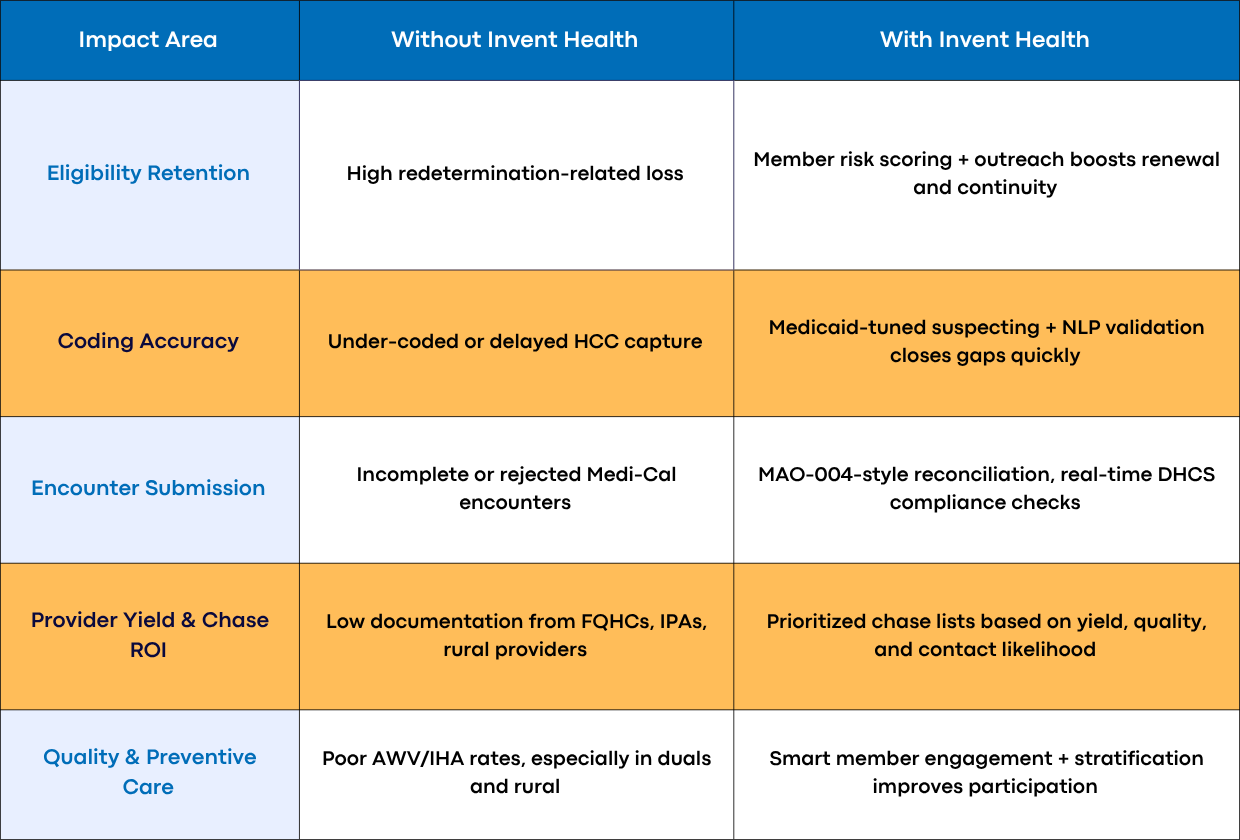
Medicaid managed care organizations (MCOs) are under growing pressure. Eligibility redetermination, chronic under-documentation, and fragmented encounter data make accurate risk adjustment and care coordination especially difficult.

Add to that line-of-business silos and variable vendor performance, and health plans risk losing not just revenue—but members and compliance standing. 

Invent Health helps Medicaid and Medi-Cal plans optimize risk capture, improve encounter integrity, and power meaningful member outreach—especially for high-need and vulnerable populations. Our Modular Analytics Platform (MAP) integrates structured and unstructured data to deliver actionable insights across redetermination, quality, coding, and financial performance. 

Highlights

Key Capabilities

AWV/IHA Optimization for Medicaid

Improve rates of preventive visit participation and documentation among underserved groups.

NLP-Driven Encounter Validation & Audit Readiness

Automatically review unstructured documentation for completeness and compliance against submission specs.

Invent Health for Medicaid

Medicaid Advantage

Use Case Snapshot

Medi-Cal/Medicaid

Plan Profile

Results

Contact us

Purpose-Built for Public Programs

Schedule a demo and see how Invent Health strengthens Medicaid performance. 

Frequently asked

Medicaid risk adjustment and intervention tracking


What makes Medicaid risk adjustment different from Medicare, and how MCOs track whether an intervention actually worked.

What makes Medicaid risk adjustment different from Medicare Advantage?

Four things, and they compound. Eligibility redetermination churns the membership, so a member's history is repeatedly interrupted. Chronic under-documentation is more common in the delivery settings Medicaid members use. Encounter data arrives fragmented across a wider provider mix. And the risk models are different: Medicaid uses CDPS, CRG, and state-specific variants rather than CMS-HCC.

Layer on line-of-business silos and variable vendor performance and the risk is not only revenue. It is members and compliance standing.

What should MCOs look for in Medicaid risk adjustment software with intervention tracking?

Intervention tracking is the part most tools skip, so test it directly: can the platform tell you which outreach worked, for which member, and what it changed.

Invent Health tracks redetermination risk by scoring member dropout risk and enabling early outreach to preserve eligibility and coverage continuity. AWV and IHA optimization improves preventive visit participation and documentation among underserved groups. SDoH-enhanced member stratification incorporates social risk factors so the highest-impact interventions are prioritized rather than the easiest to reach.

Beyond intervention tracking, the Medicaid-specific requirements are suspecting logic aligned to Medicaid models including CDPS, CRG, and state-specific variants, and encounter submission integrity and reconciliation for the relevant state authority. For California plans that means Medi-Cal submissions to DHCS and MCP compliance.

How does Invent Health handle members who churn between Medicaid, Medicare, and ACA?

Through cross-line-of-business integration for duals and churned members, which unifies data across Medicare, ACA, and historical Medicaid coverage for consistent longitudinal suspecting.

Churn is the core analytic problem in Medicaid. A member who leaves and returns looks like a new member to a system that cannot see prior coverage, and every previously documented chronic condition has to be rediscovered. Linking the history is what stops that reset.

Which Medicaid risk models are supported?

CDPS, CRG, and state-specific variants, with suspecting logic tailored to each rather than a Medicare model applied to a Medicaid population.

Medi-Cal encounter submission integrity and reconciliation is supported for California DHCS and MCP compliance requirements.

How do we improve encounter data quality for state submissions?

Encounter submission integrity and reconciliation ensures data reaching the state is clean, complete, and timely. Chart audit prioritization identifies and prioritizes records with missing or inconsistent data so completeness improves where it affects submission first.

The compliance stake is direct: incomplete or late encounter data affects both the risk-adjusted payment and the plan's standing with the state.

Can we address health disparities and risk capture in the same workflow?

That is the design intent of SDoH-enhanced stratification. Social risk factors feed the prioritization so interventions are targeted at high-impact members and disparities are reduced rather than reproduced by an outreach model that favours the easiest members to reach.

AWV and IHA optimization for Medicaid works the same way, improving preventive visit participation and documentation specifically among underserved groups.

Our Blog

Healthcare Insights,
Made Simple

Explore expert perspectives on risk adjustment, AI-powered analytics, and healthcare innovation. Stay informed with actionable insights designed for health plans, providers, and managed care organizations.

How NLP Improves HCC Capture Accuracy

How NLP Improves HCC Capture Accuracy

See how NLP lifts HCC capture accuracy by surfacing evidence, keeping a coder in the loop, and measuring capture where it pays: CMS acceptance.

Top 20 MA Plan Selects Invent Health for AI Risk Adjustment Coding

Top 20 MA Plan Selects Invent Health for AI Risk Adjustment Coding

A top 20 Medicare Advantage plan has selected Invent Health and gone live on Coder Workbench 2.0. AI-assisted risk adjustment coding that runs natively inside…

Immunization Care Gaps: 3 Leaks Costing Plans Stars

Immunization Care Gaps: 3 Leaks Costing Plans Stars

Why do vaccinated members still show as immunization care gaps? The three data leaks that cost plans Stars revenue, and how to find yours by…